In Term 1, we learn about the structure of the atom. We learn about protons, neutrons and electrons. We also learn about isotopes: atoms of the same element with different neutrons.
How can we apply all these for the benefit of mankind? What is the purpose of learning these? What are the applications of learning something so small that it is hard to even visualise? Sometimes, I ask myself why I am learning all these stuff. Eventually, I found out. All of this knowledge about the atomic structure does have its applications – that’s rights more than just one application. However, today I shall talk about just one of its application: radioactivity.
Radiation is found everywhere around us. Apart from X-ray scans, nuclear power plants and atomic bombs, radiation can be found in our daily objects (in minute amounts of course) such as bricks, concrete, smoke detectors and surprisingly, bananas! But all that does not explain what radiation really is. Radiation is the particles or energy which leaves the atom when it undergoes radioactive decay. Firstly, we know that protons (positively-charged subatomic particles) are found in atoms; and we also know that particles of the same charge repel each other. So what keeps the protons together? Neutrons. Neutrons exert a force called the strong nuclear force which pulls everything within the nucleus of the atom together. However, as atoms possess too much energy for the strong nuclear force to bind the subatomic particles together, the atom needs to lose some neutrons or protons to get the right number of neutrons and protons. This is radioactive decay.
There are 3 types of radiation. The first one is Alpha radiation. It is made up of 2 protons and 2 neutrons. It is ejected out of an atom with too much energy (because it has too much mass). The second kind of radiation is Beta radiation. It has the mass of an election and its charge is either +1 or –1. When an atom has too many neutrons, it converts neutrons into protons. In the process, a negatively charged particle – an electron is ejected out of the nucleus. When an atom has too many protons, it converts a proton into a neutron. A proton can be expressed as containing a positively charged particle and a neutral charged particle. The neutral particle is the neutron and the positively charged particle is a positron, which is the exact opposite of the electron. Finally, in any decay energy is released. This energy is Gamma radiation, the third form of radiation.

However, all of these still does not tell us the applications of radiation. Now, I come to the main part of this essay: the applications of radioactivity. One of the well-known applications is in nuclear power plants. Nuclear power plants tap on the fission (breaking apart) of unstable atoms (most commonly Uranium 235). Uranium 235 breaks apart into two other atoms of almost equal masses when hit by a slow moving neutron. This releases lots and lots of energy which heats and boils water to turn the turbine and generate electricity.
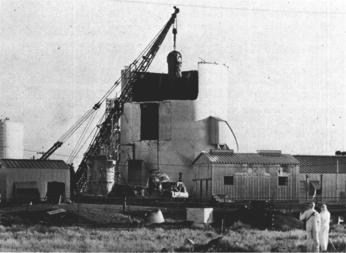
However, there are many problems associated with nuclear power plants. Firstly, it is the fear of a nuclear meltdown or worse, an explosion. Perhaps the two most infamous incidents of a nuclear meltdown were the Three Mile Island and Chernobyl. However, there was one more nuclear reactor accident which had happened before these two accidents. It happened on the US Army’s SL-1 experimental nuclear power plant. One day, when the reactor was being started up, the operators had to pull up the main control rod by hand while standing on top of the reactor. He pulled it up to quickly, causing the radioactive fuel to release too much energy which caused steam in the reactor to be formed too quickly. The result was a steam explosion which blew apart the reactor. All three operators there died. It was the United States first and only fatal nuclear reactor accident (not Three Mile Island where no one died). Another problem is the disposal of high-level nuclear waste. Such nuclear wastes are extremely dangerous and when they enter the drinking water supply, they can pose a threat to the people who drink it. Up till date, there has been no permanent way of disposing such wastes.
 |
| SL-1 Experiment Nuclear Plant |
Apart from nuclear power plants, radiation can be found in our household items and our food. Radiation is often used in research of food and chemical products. Radiation can act as a tracker to track substances. For example, radiation is “attached” to toothpaste to show what happens when we use it to brush teeth. Radiation can also be used in process control. Companies producing sheets of metal might use gamma rays to ensure that the sheets of metal are of the correct thickness. Gamma rays are also used to sterilize food and medical products such as bandages. Radiation is also used in smoke detectors. When smoke enters the smoke detectors, it deflects radiation and causes a drop in radiation. The amount of radiation is very little and people are more likely to die without smoke detectors. According to the National Fire Prevention Association (2011), 40% of all home fire deaths resulted from fires in homes with no smoke alarms.
Radiation is becoming widely-used in the medical industry. Radiation can both kill and heal. It ionizes cells to form free radicals which can damage DNA and cause cancer. Higher doses of radiation can kill the White Blood Cells in our bodies and weaken our immune system. Radiation can be used to cure cancer too. There are too ways of doing so. One way is to inject radioactive substances into the body. Radioactive iodine can be injected into a person suffering from thyroid gland cancer. The thyroid gland absorbs iodine so only the thyroid gland would receive a higher concentration of radioactive iodine. The other way of killing cancerous cells is using a machine known as a Linear Accelerator. A Linear Accelerator fires many beams of X-rays which converge at the tumor. Thus, only the tumor receives the deadly dosage of radiation; the rest of the body remains safe. Radiation can be used to identify tumors too. If a patient has brain cancer, he can undergo a PET (Positron Emission Tomography) scan. The patient is injected with glucose or some biological molecule that contains radioactive atoms. The glucose is taken up by the brain as it undergoes metabolism. When the radioactive atoms decay, they release positrons which when they meet electrons, vanish in a burst of gamma rays. These gamma rays are captured using a gamma camera. Since cancerous cells have high metabolism rates, they will absorb more radioactive glucose and emit more gamma rays.
 |
| Linear Accelerator |
Radiation is found everywhere around us and does not harm. Minute traces of radioactive elements (uranium in particular) can be found in the material dug out from the ground such as clay and fossil fuels. In fact, the burning of fossil fuels might just release as much if not more uranium into the atmosphere. Radiation can even be found in our food and our bodies. All living things are made up of carbon. While most of this carbon is stable Carbon 12 atoms, some are the radioactive Carbon 14 atoms. Furthermore, food that is rich in Potassium (an important metal needed by living things) such as bananas contain minute traces of the radioactive Potassium 40.
It appears that while radiation appears to be a scary notion, it is not as deadly as we thought. In fact like most substances, radiation is only deadly in high concentrations which are hard to come by. In fact, radiation helps more than it harms.
Like any other scientific discovery, radiation appears to be deadly because we do not fully understand it. As we probe deeper, we realise that there is nothing to be afraid of. I believe this is one of the amazing things about science: the more we understand, the less fearful we become.
I believe here I have finally answered my question: Why do we need to learn about the Atomic Structure? So that we can understand about radioactivity so that we can able to harness radioactivity to our advantage.
References
1. Karam, P. & Stein, B. (2009). Radioactivity. New York, USA: Infobase publishing.
Picture sources